Megan Thee Stallion & the Hot Girlification of Geek Culture
“Fake geek girl?” Do you even know the lore?
Formerly a tool for demeaning and excluding women from male-dominated fanbases, the phrase “fake geek girl” phrase is falling apart at the seams. Through icons like Megan Thee Stallion and her discography of anime-inspired tracks, this once-niche interest has surged further into the mainstream. A new generation of geek girls has emerged in response to the rampant discrimination that women tend to face within fandom spaces. With Thee “Otaku Hot Girl” taking pop culture by storm, the fandom world is entering a metamorphosis — a ‘hot girlification,’ if you will.
The Life & Death of the ‘Fake Geek Girl’ Agenda
The “fake geek girl” stereotype gained traction in the early 2010s, particularly within online fan communities. Though its origins are murky, its surge into mainstream conversation could be traced back to the Idiot Nerd Girl meme from 2010. Variations of this image were used to parody women who identified as nerds or geeks, igniting debates about gatekeeping and misogyny in fandom communities. One popular thinkpiece that arose from the discourse was a 2012 Forbes post by Tara Tiger Brown. In her piece, “Dear Fake Geek Girls: Please Go Away,” she laments the apparent over-saturation of “geek culture.” Unlike the 1990s when “geek” was used to tease the socially inept and fandom-obsessed, Brown claimed it was now co-opted by “muck” and “pretentious females.”

For some, viral media like the Idiot Nerd Girl meme and Brown’s post affirmed their biases against girls in male-dominated fanbases. By gatekeeping interests like anime, comics, and video games, they believed they were preserving the sanctity of their beloved subculture. However, it was evident to many — women especially — that this angle only reinforced the gender-based exclusion that has long existed in these spaces.
“The only purpose of fake geek shaming is to exclude newcomers, particularly women, from fandom. It’s part of the reason so many women are too intimidated to get into geek culture,” wrote Olivia Liccione in her 2016 article in The Odyssey. “If you don’t have an instant encyclopedic knowledge base, there’s a distinct possibility you’ll be humiliated out of the fandom.”
Ultimately, the gatekeeping of geek culture was always a deeply gendered issue. Earning credibility within a fanbase was not a matter of shared passion, but rather of meeting the criteria set by its male majority. Women had to prove themselves worthy of being called “real fans,” whereas their male counterparts were often granted legitimacy by default. It is also historically tied to a lack of female representation in male-dominated franchises like science fiction, despite many women pioneering the genre.
During the 1970s New Wave era of science fiction, a feminist revolution swept the fandom landscape. Prior to this, the first-ever World Science Fiction Convention (WorldCon) was established in 1939. As the genre gained mainstream popularity, so did a desire among female fans to explore it critically. However, the existing platforms, which were dominated by men, often overlooked female voices at their events. In response, WisCon was founded in 1977 as a space for women to celebrate science fiction as a sisterhood. It also strived to foster conversations about the genre through an intersectional feminist lens, though at the time, the term was not yet coined.
Years later, the discourse has shifted. Not only is the “fake geek girl” label past its expiration date, but so is the obscurity of geeky interests. Video games, comics, and especially anime are now more mainstream than ever. Much of it can be attributed to the popularity of streaming services like Crunchyroll, which have made anime widely accessible worldwide. However, it also has to do with a cultural force working to land a fatality on the “fake fan” agenda for good.
Yes, 2024 is the year of otaku hot girls.
Thee Feminization of Fandom: A New Challenger Approaches!
In June 2024, Megan Thee Stallion piqued the interest of hip-hop and anime fans alike with “Otaku Hot Girl.” To the delight of Jujutsu Kaisen fans in particular, the track features voice actor Adam McArthur, who portrays the series protagonist Yuji Itadori in the English dub. As a whole, the song is rich in evocative references to some of the most famous anime of all time. From allusions to Gojo Satoru’s “Limitless” technique to Sasuke Uchiha’s “Sharingan,” Megan calls upon anime’s strongest techniques to vanquish her opponents.
“No doubt one of the most influential and visible anime lovers in recent years, she’s on the forefront of the movement to make anime cool again,” Kira Deshler writes on The Daily Dot. “For fans of Megan’s music and of anime, this crossover is a match made in heaven.”
To those who have followed her musical journey for a while, “Otaku Hot Girl” is Megan at her best. She has waved her geek flag for as long as fans can remember, from wearing Naruto merch at a Coach fashion show in 2019 to collaborating with Crunchyroll on exclusive apparel. She even presented at this year’s Anime Awards, showcasing her love for anime on an even bigger and brighter stage.
This aspect of Megan’s brand is remarkable for more reasons than one. Not only does it have massive crossover appeal, but it also intertwines pop culture with female empowerment. Her impact is specially made for Black girl anime fans, who are disproportionately at the brunt of “fake geek girl” accusations.
“To men, and some women with internalized misogyny and what I like to call Lone Geek Girl syndrome, Black girl nerds are the ultimate ‘fake geek girls’ because we really don’t look like the ideal image of anime fans in the United States,” Teen Vogue contributor Stitch wrote in their 2020 op-ed. “I know this because I lived it. I was subjected to knowledge tests, questions about (official) merchandise purchases, and demands that I, a supposed interloper to nerdy spaces I’d been part of since I could be trusted to go to a comic book store on my own, proved that I belonged.”
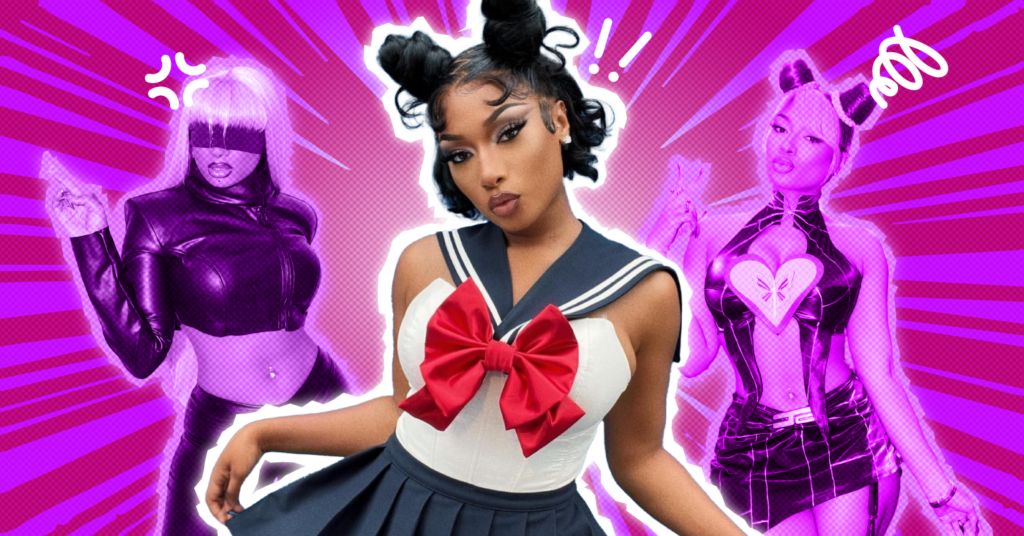
By leading the example as a proud “weeb and baddie,” Megan inspires her hotties to claim their place in fandom — especially Black geek girls. Despite a lingering bias toward female fans who present themselves as outwardly feminine, Megan is proving that the two are not mutually exclusive. The Hot Girl Coach has stunned with jaw-dropping cosplays, showcased anime-inspired nail art, and put her fan knowledge to the test with anime trivia. Now more than ever, owning labels like “geek” and “weeb” does not have to mean rejecting femininity, even if a male-dominated fanbase argues otherwise.
“Neva Play” Debuts as WWE SmackDown Theme Song
As if her streak couldn’t get any hotter, Megan has now ventured into uncharted territory: professional wrestling. On September 13, 2024, WWE announced “Neva Play” by Megan Thee Stallion featuring RM of BTS as the opening song for Friday Night SmackDown. Given the record numbers WWE hit this year, it is safe to say that this was to further the company’s mainstream reach. However, this song change was not without criticism, especially in one of the most male-dominated franchises in history. The backlash is a familiar refrain, one that echoes the cries of gatekeepers in geek culture from the past decade.
Even so, Megan’s entry into the world of sports entertainment is incredibly telling of her multifaceted impact on pop culture. Wrestling, a sport that has long been associated with hyper-masculinity and a predominantly male fanbase, has been evolving. With female wrestlers like Rhea Ripley and Bianca Belair gaining mainstream popularity for their athleticism and talent, Megan’s involvement adds a whole other layer.
Simply put, Hot Girl Meg is one of the biggest topics in professional wrestling right now. The two largest wrestling companies in the world have gone head-to-head over her, and she still has yet to step into a ring. On top of that, her collaboration with RM of BTS makes the partnership with WWE even more powerful. Both artists have defied stereotypes in their respective genres by creating music that transcends boundaries and crosses over diverse fanbases. Together, they’re showcasing what it means to wrestle with doubters and, most importantly, win the match.
For Geek Culture, the Future is Female
No matter the franchise, Megan Thee Stallion is blazing the trail for young women to take up space. Trivialization and gatekeeping have done far more harm than good, disguising prejudice as a desire for authenticity. It also deters potential fans who are made to feel unwelcome from the get-go, which is ultimately counterproductive. The more eyes that are on a product, the more it thrives. The myth of falsified fandom has distracted from every fanbase’s motivation: sharing a beloved interest and watching it succeed.
From One Piece to Attack on Titan, some of the greatest franchises of all time are made better by their female characters. However, while the women on the screen are readily embraced by their viewers, the ones who are watching face criticism. To quote Nobara Kugisaki from Jujutsu Kaisen, “What makes us obligated to meet such perfection or such absurd standards?”
Still, with public figures like Megan leading by example, geek culture is evolving like never before. It is more evident than ever that joining a fanbase, male-dominated or not, should not have to be earned. One pop culture moment at a time, Megan Thee Stallion is proving that fandom thrives most when everyone has a seat at the table.
Want to read about more pop culture crossovers? Check out EnVi’s article on League of Legends and Linkin Park’s recent collaboration here!