Two Envi Writers Explore Guillermo del Toro’s Newest Monster
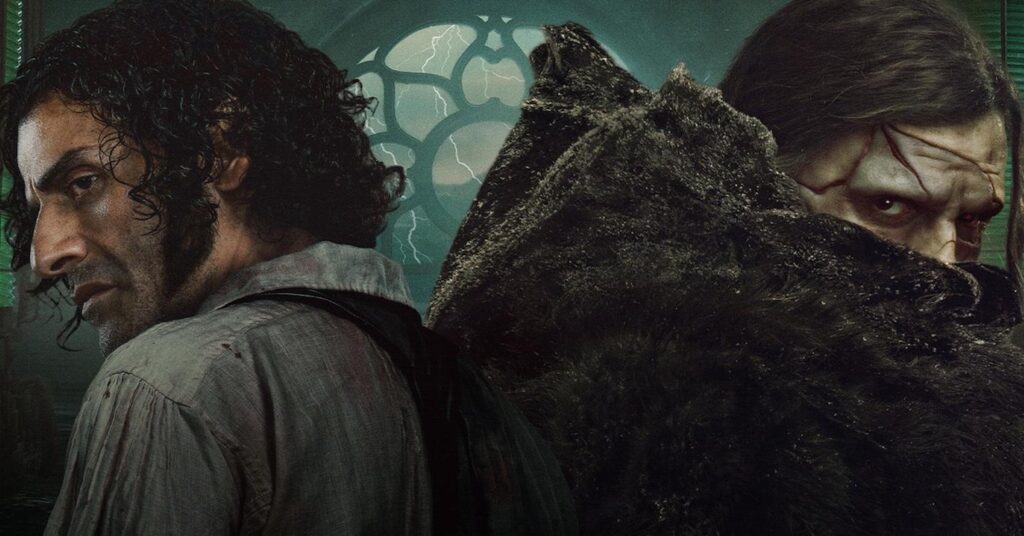
Having a complex upbringing with religious experiences that deeply shaped him, Guillermo del Toro has long poured himself beautifully into monsters and fantasy-horror creatures as a way to express the emotional echoes of his past. Through these creations, he transforms personal wounds into stories of purity and resilience. His recent work of art, Frankenstein, is an homage to a dream he’s had since the age of eleven.
The most influential figure in English literature for him has always been the pioneering Mary Shelly, the visionary author of Frankenstein (also known as The Modern Prometheus, 1818). In his own moving words during his BAFTA acceptance speech, del Toro said, “So many times … when I think about giving up, when people tell me that dreaming of the movies and the stories I dream is impossible, I think of her, because she picked up the plight of Caliban, and she gave weight to the burden of Prometheus, and she gave voice to the voiceless and presence to the invisible, and showed me that sometimes, to talk about monsters, we need to fabricate monsters of our own.” In this article, two EnVi horror enthusiasts delve into his latest reimagining of a timeless and highly regarded classic.
What was your viewing experience having watched the film first or read the novel first?
Cindy: Having read the novel first, I can’t deny that I went into the film with a palpable bias. On the first watch, I found myself constantly comparing scenes to the novel, and I expected to know exactly what would happen in the next scene as if I was a seer. I was quickly disproven by changes in the film, diverting from the expected and I was taken by surprise by the unexpected. I have always envisioned the world of Frankenstein in my mind, but it was an entirely breathtaking experience to step into the imagination of Guillermo del Toro in his vision of the story we both held true and close to us.
Crista: I watched the film first, and I’m currently reading the book. Going into the novel, I fully expected the film to follow a similar plot, but I was pleasantly surprised to find differences right away. It felt important to read the original story not only to see how well the film honored it, but also to appreciate such a classic in its pure form. At first, I was confused by all the contrasts, but I quickly realized the tweaks made in the screen production were reinterpretations that added their own meaning. Even though the film ended up being very distinct, I wasn’t upset about it at all. Normally, I’m not a huge fan of film adaptations altering major parts of a story, but del Toro did a spectacular job delivering an equally revitalising and moving narrative of the Creature. I found myself sympathizing with him in both versions. In the end, it made me realize that classics can be reimagined in their own beautiful ways that still honor the original story.
What distinguishes this Frankenstein adaptation from the original novel and previous film versions?
Cindy: Del Toro changes Victor’s motivations and backstory to create a character damaged by a broken father-son relationship and the death of his mother. As opposed to the novel Victor, who had a picture perfect, non-traumatizing relationship with his family, del Toro’s protagonist’s inner wounds bleed into his bond with his creation, adding another layer of commentary of the cycle of intergenerational trauma. Del Toro himself calls his film more of a family drama than a horror movie. I thought this change, along with del Toro’s depiction of the story through a Mexican/Latino framing, brought a unique, melodramatic, telenovela-esque narrative.
Crista: Guillermo reframes this story through a Mexican/Latin American lens using religious imagery, family dynamics, and novela-like action, to name a few. In an interview with horror movie enthusiast Monse, Guillermo explains, “I painted the archangel because I wanted it to look like a Mexican colonial archangel. The pageantry of the Catholic [elements in the film] is very Mexican, and the melodrama of father and son is very Mexican.” These changes in the film were the most significant to me because they meant a lot to see Latino culture be appreciated within a widely celebrated story. It reframed the story in a way that created a much deeper focus on trauma and tenderness. I appreciate that del Toro’s narrative emphasizes the emotional consequences of trauma rooted in Latino experiences, as it tells the bittersweet story of how pain is passed down through generations, yet love still finds a way to become a form of survival.
What was your favorite moment in the film?
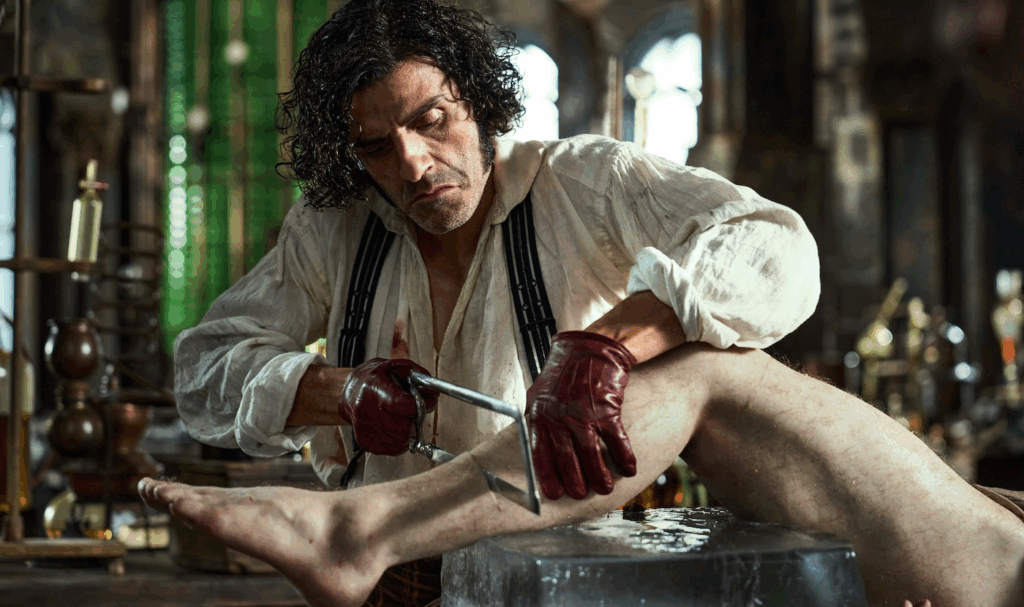
Cindy: I was enraptured by the montage sequence of Victor assembling his creature. The mystical and wondrous soundtrack that played while Victor unceremoniously hacks and saws away limbs was brutal and beautiful. I thought this scene exemplified Oscar Isaac’s and del Toro’s reenvisioning of Victor as an artist rather than a mad scientist. In the midst of Victor’s chaotic construction, the anatomy of the human body is celebrated, and ironically, despite Victor’s perverted desire to defy death (as opposed to creating life), there is an artistic fluidity and tenderness in the way that he dexterously reconnects tendons and sews skin like a patchwork portrait.
Crista: Among the many moments that struck me most in the film, I can’t choose between two. The first was the scene where Elizabeth challenged Victor’s vision and bluntly called him a fool. I loved this moment because it felt like an act of empowerment — her first words in the film are a refusal to agree with him. Considering the time period, where women were looked down upon when they questioned men, Elizabeth standing her ground and bringing logic into the conversation felt bold and liberating. The second scene that lingered with me was when the Creature returns to an injured De Lacey and has a moment with him before his death. He shares what he had just learned about himself, that he was built out of discarded dead, and calls himself a monster. Instead of De Lacey being disgusted by this, seeing as he is blind and was never able to actually see the Creature, he responds by empathizing with him and reassures him that he is a good man, and more importantly, his friend.
What aspects of the production process stood out to you?
Cindy: I was most taken by the costume design, especially Elizabeth’s wardrobe. Costume designer Kate Hawley based the outfits’ colors, patterns, and structures from Elizabeth’s love of insects, as well as drawing from the overall theme of the human body. The masterful and thoughtful work from Hawley is beautiful and weird, in the best way possible. From Elizabeth’s blood cell dress to her moth wing patterned shawl, it truly felt like Elizabeth was an incarnation of the film’s visual soul. In the best way put by Hawley herself, “Where anatomy, color, and the spine align, the theology of nature emerges.”


Crista: One of the first things I learned about the making of the film was the fact that many of the background scenes and props were real rather than digitally created or significantly altered. Two examples fascinated me the most. The first was the frozen lake sequence. Oscar Issac recalls how unprepared the crew was for the unexpected conditions. On their first day of filming, it was much warmer than they had originally expected, and they were losing the fog that was essential to the scene where Victor comes out of the cave. He was in the middle of getting a large beard applied when, despite the lack of rehearsal, del Toro urged the team to capture the moment as fog was finally forming. It’s behind-the-scenes moments like this one that remind me of how much patience and luck it takes to create a driven film like Frankenstein. The second example that spiked my interest was the ship. Del Toro insisted on avoiding VFX, explaining, “I want a real ship because the ship is a character … so we mounted [it] on a mechanical gimbal, because I didn’t want the audience to go, ‘Oh, it’s digital’ because once you introduce that, it’s like a license for people [to not] believe things.” He wanted the Creature’s strength to feel authentic on screen, and the ship was a huge part of that. He describes the final result as “a huge feat,” reflecting that true dedication pays off.
What themes/visuals seem uniquely Guillermo, and how do they enhance this retelling of Frankenstein?
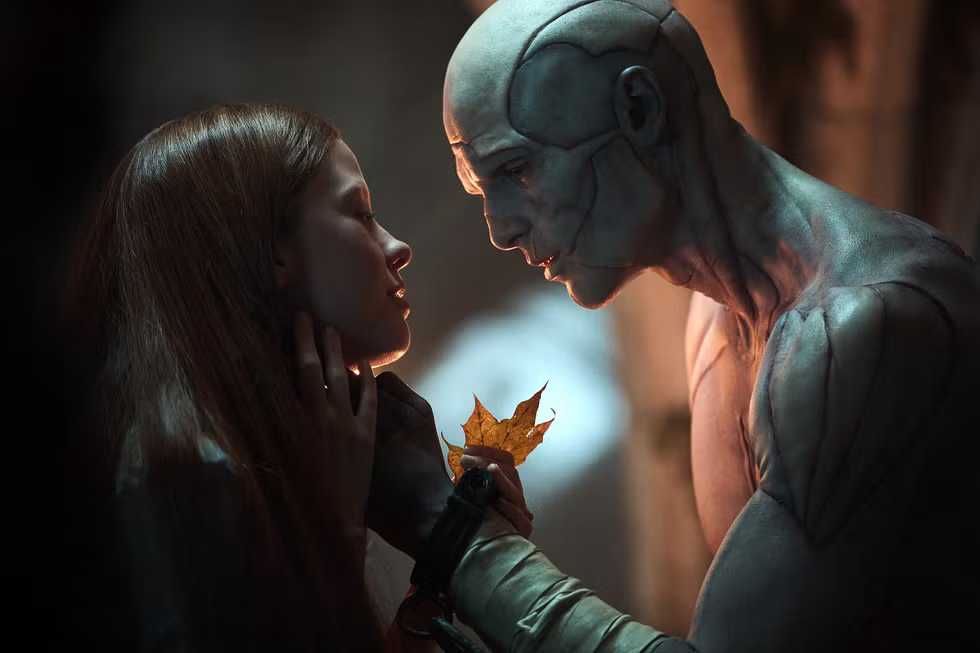
Cindy: Sexy and sympathetic monsters. Horror fantasy magical realism. Movies that feel like a fever dream. I would consider Frankenstein to tick off all these boxes on classic Guillermo del Toro characteristics. Visually, the Creature is beautiful, and having Jacob Elordi play him certainly helps too. Del Toro asserts that his monsters have an “aesthetic signature, that makes them all feel like that they came from the same hand and the same mind.” The Frankenstein creature is an extension of that intention, to which del Toro calls “operatic” to his past monsters. For a story that is occupied with the nature of humanity and monsters, del Toro’s touch is emulative of how beauty coexists with the grotesque.
Crista: Del Toro’s retelling is embellished by themes and visuals that radiate his signature style. He is famously known for using symbolism all throughout his work and for constructing sets that become essential to his plots. He goes above and beyond to create fantasy-horror productions that are immersive and rich in feeling. His approach at blending mythical elements with heartfelt ones make each of his scenes feel dreamlike. Beyond this, he’s fascinated by the beauty of monsters and crafts them for his audience to relate to and see magic in them. He’s meticulous about little details, weaving depth into the fabric of his scenes that reward attentive viewers. In his cinematic world filled with enchanting and misunderstood monsters, there is so much to unfold. These characteristics all enhance the Frankenstein story by bringing the Creature to life in a new way, almost granting him renewed purpose and offering reimagined ways to relate to him.
In what ways did you connect or sympathize with the creature differently in this adaptation than in previous ones and/or the novel?
Cindy: The greatest difference between how I sympathized with the Creature in the novel versus in del Toro’s film lies in the substance of the Creature’s character, with del Toro’s rendition being less morally gray than the novel. I sympathized with the Creature in the novel because he wrecked havoc, murder, and destruction from a place of both ill intent and deep sorrow and pain. I sympathized with him because he was made a monster on the basis of political and societal erasure. I sympathized with him because he is just as monstrous as humans are. In a different manner, when we first encounter del Toro’s Creature, we see his first steps, his first words, his first laugh. I felt endeared and maternal towards this creature that is victimized from the perpetual violence around him. I found myself yelling at my screen whenever Victor was being mean to the Creature. Del Toro is especially good at building a monster that you root for.
Crista: I’ve watched many renditions of the Frankenstein tale over the years, but what captivated me most about this one was its focus on the Creature’s fragility. I felt an overwhelming sadness watching him navigate through inconceivable pain and confusion, almost always alone. When faced with new things, he showed hesitancy because of fear, yet he was gentle with what he did, and even when in pain, he strived to understand everything and everyone around him. The beauty of his forgiveness was what reframed my perception of him as a character, one capable of compassion despite unimaginable suffering; it left me grieving for him. His gentleness felt more palpable and sincere in this version, less like a monster and more like a child who had never been taught anything with kindness. Previous adaptations often highlight his destructive side, but this film gave the iconic character a new meaning for me – there’s a softness to him. I was reminded of how the real monster was always Victor, how the Creature was more human than Victor ever allowed himself to be.
In what ways does the film challenge the traditional concept of a ‘monster,’ and how does Guillermo del Toro’s depiction of father–son relationships and inherited trauma contribute to this reinterpretation?
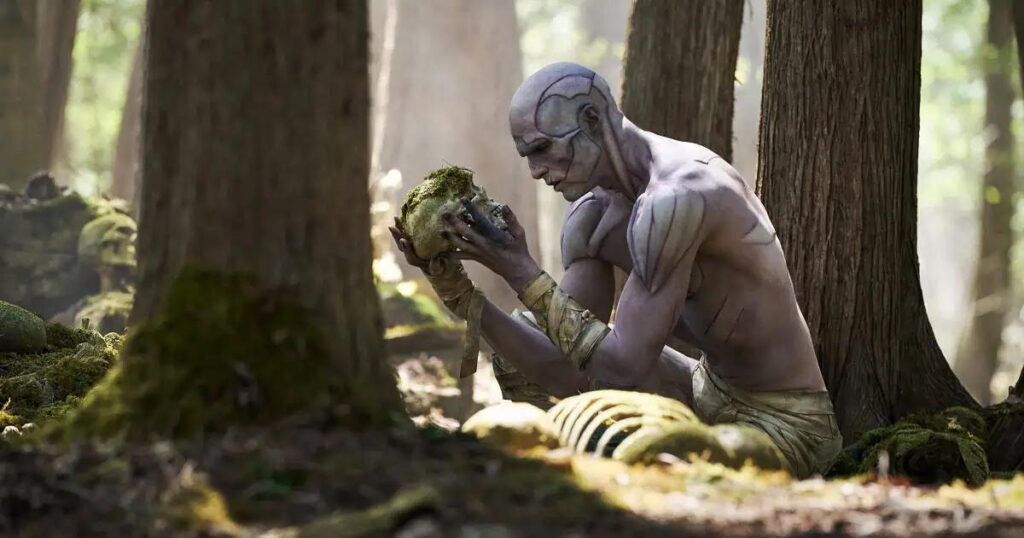
Cindy: Monsters make evident our fears, anxieties, and the most hideous part of ourselves — as something to be hidden and defeated, much like death itself. Yet, del Toro creates an undying monster, one that cannot escape life, its animateness a curse. As Victor lies on his deathbed, the same force that birthed his creature who he now calls his “son,” now fading him, he tells his son to live on and to live better than he did. The cycle of death, birth, and trauma persists, but with this acceptance from his father, the creature lives—brokenly and arduously most likely, but still the monster lives.
Crista: In Mary Shelley’s Frankenstein, she paints the Creature as innocent and capable of love and deep emotion. It’s only after Victor’s initial disgust turns him into a coward and casts him aside that he converts the Creature’s sorrow into anger and forces him onto a path of revenge. Thus, Victor is painted as the real monster in the story, making it an ironic tale about how his creation shows more emotional awareness and maturity than he ever does, despite having no guidance or experience. Del Toro’s version preserves this message, apart from injecting his own ancestral style into it by using Catholic symbolism, Mexican-gothic elements, and deeply exploring father-child wounds. I appreciate that he kept the heart of Shelley’s main intention with the tale, because this theme is one of the most profound messages in the original novel. Del Toro’s contribution to this reimagining is the father-son wounds through a distinctly Mexican cultural lens. Through this, the film reframes the traditional concept of a ‘monster’ by highlighting the consequences of paternal absence, suggesting that monsters are created through emotional wounds rather than birth or creation. This approach serves as a poignant and resonant contemporary retelling in a way that not just speaks to Mexican audiences, but to immigrants as a whole who recognize the emotional weight of fractured lineage.
Why does it matter now for this rendition of Frankenstein to be released?
Cindy: Del Toro likens the creation of an adaptation to “marrying a widow. You have to be very respectful of the late husband’s memory, but you know, now and then you have to party like it’s 1999.” This adaptation of Frankenstein contains many differences from its original version, and as a fan of the novel, I have my critiques and reservations. But much like Shelley made a statement of her personal life and cultural surroundings at the time, del Toro does the same in his own contemporary vision. It’s noteworthy to have a rendition in a postcolonial context, with the representation of Latin identity, and Mexican cultural production in the film canon.
Crista: In today’s society, I believe it’s evident to highlight stories like this one, where one of the main themes is accountability. Frankenstein is surrounded by trauma and generational wounds, making those relevant topics to introduce to modern audiences that are progressively becoming more open to vulnerability and learning how to heal wounds. The movie achieves a sublime portrayal of humanizing Victor in a way that many can relate to by showing how having a difficult upbringing shapes one’s decisions. In an interview with Rotten Tomatoes, Oscar Issac explains that the idea of the father-son trope emerged when he and Guillermo were discussing their own fathers and the emotional damage that men often inherit. He explains that in an effort to run away from that trauma, they ironically adopt the same behaviors, and unintentionally pass on the hurt to their children. He then mentions his character Victor and how his spirit was one of defiance, “That’s kind of what fuels him, his defiance against his father, against death, against the death of his mother … That kind of myopic vision that, yes, allows him to do amazing things, but also allows for incredible cruelty, a blindness.” In a time where audiences are craving raw and resonant storytelling, del Toro’s rendition reminds its audience that confronting inherited pain and redefining inner trauma is where accountability begins and changes a person.
Conclusion
Del Toro’s Frankenstein has captured the hearts and minds of many through its distinctive approach towards the gothic aesthetic, the dedicated production design, and exploration of intergenerational trauma. The story of Frankenstein, after more than two centuries, continues to be a classic that drives culture. Del Toro honors the craft and spirit of the novel in a love letter of his own within this twenty-five year long passion project.
For Frankenstein lovers, the director confirmed himself that the film will be getting a physical media release with the inclusion of a deleted scene, a major feat as Netflix releases are mainly exclusive to the platform. In the meantime, you can stream Frankenstein exclusively on Netflix (for now).
Interested in more movie reviews by EnVi? Check out our recent review of In Your Dreams here!